
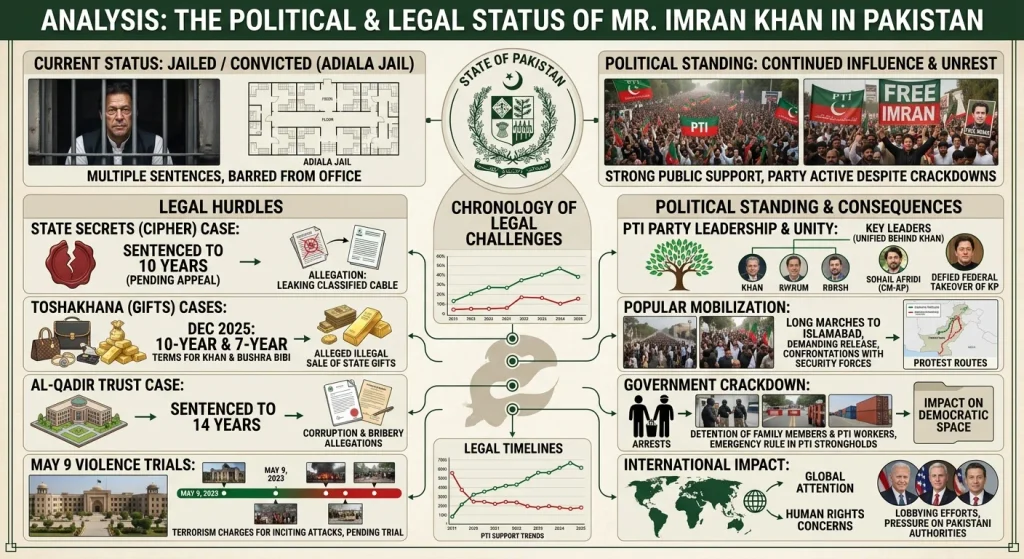
Imran Khan, Pakistan’s former prime minister and founder of Pakistan Tehreek-e-Insaf (PTI), remains at the centre of the country’s political crisis. Despite being in prison since August 2023, he continues to influence opposition politics, while his party is facing legal challenges, restrictions on political activity, and growing tensions with the federal government.
The political situation has become more complicated following the federal government’s decision to impose emergency rule in Khyber Pakhtunkhwa (KP), a province previously governed by PTI. At the same time, questions surrounding Khan’s access to his family, lawyers, and medical care have continued to generate political debate.
As of November 4, 2026, Khan remains incarcerated, PTI continues to demand his release, and negotiations between the opposition and the government have yet to produce a clear political breakthrough.
Is Imran Khan Still in Jail?
Yes. Imran Khan remains imprisoned at Adiala Jail in Rawalpindi.
He was arrested in August 2023 following a series of legal cases after his removal from office in April 2022. Since then, he has faced multiple proceedings involving corruption and other allegations.
Khan has denied wrongdoing and maintains that the cases against him are politically motivated. PTI has also repeatedly described his imprisonment as politically driven.
The legal position has changed over time as different court decisions have overturned, suspended, or affected individual convictions. However, those developments have not resulted in his release.
His imprisonment remains one of the central issues in Pakistan’s political confrontation.
Why Is Imran Khan’s Access to His Family and Lawyers a Major Issue?
Access to Khan inside prison has become a recurring point of disagreement between PTI and the authorities.
On November 3, 2026, Dawn reported that Khan’s nephew was denied permission to meet him at Adiala Jail, despite Tuesday being a designated meeting day under Islamabad High Court arrangements.
The court had allowed meetings twice a week with family members, lawyers, and other associates. However, PTI representatives have repeatedly complained that these meetings have not taken place consistently.
There was one significant development shortly before that report. On November 2, Khan’s lawyer, Barrister Salman Safdar, was allowed to meet him after a gap of approximately seven months. The meeting lasted around 40 to 45 minutes and took place in the presence of Khan’s wife, Bushra Bibi.
According to PTI representatives, the meeting focused mainly on ongoing legal proceedings and the former prime minister’s situation.
The restrictions on meetings have become an important part of PTI’s demands, with the party calling for court directions to be implemented and regular access to Khan to be ensured.
What Happened to PTI’s Government in Khyber Pakhtunkhwa?
One of the most significant developments in Pakistan’s political situation occurred on October 11, 2026, when President Asif Ali Zardari declared a state of emergency in Khyber Pakhtunkhwa.
The decision suspended the provincial government previously led by PTI.
The federal government defended the move by citing security concerns and accusing the provincial administration of failing to address rising militant activity. Government officials also alleged that the suspended administration had failed to cooperate adequately with federal counterterrorism efforts.
PTI rejected the allegations and criticised the emergency decision, arguing that it was an attempt to undermine the party’s political position.
The development increased tensions between the federal government and PTI because Khyber Pakhtunkhwa had been an important centre of the party’s political influence.
It also complicated PTI’s plans to organise protests demanding Khan’s release.
Why Is PTI Demanding Imran Khan’s Release?
PTI’s central political demand remains the release of its founder.
The party argues that Khan should receive fair legal proceedings, access to his lawyers and family, and the opportunity to participate in Pakistan’s political process.
PTI has also raised concerns about restrictions on its political activities and the detention of party members.
The federal government, meanwhile, maintains that legal cases and security measures should be dealt with according to the law. Government representatives have rejected the idea that Khan’s release should be treated as a condition for avoiding legal proceedings.
This disagreement has made negotiations difficult.
For PTI, Khan’s imprisonment is the main issue connecting its legal, parliamentary, and street-level political activities. For the government, the cases involving the former prime minister remain matters for the courts.
What Is Happening Inside PTI?
Although Khan remains the party’s central figure, PTI is also dealing with internal organisational challenges.
A report published by Dawn on November 3 described disagreements within the party’s political committee over leadership responsibilities and the strategy for securing Khan’s release.
Some members reportedly questioned the performance of senior party figures, while discussions also focused on internal disciplinary matters.
PTI Chairman Barrister Gohar Ali Khan and Secretary General Salman Akram Raja remain among the party’s prominent organisational figures.
The party has rejected suggestions that it is breaking into separate factions and has publicly maintained that it remains united behind its founder.
Nevertheless, disagreements over strategy, leadership, negotiations, and protest planning have created additional challenges for the opposition.
Could PTI Form an Alliance With Other Political Parties?
PTI has indicated that it is open to cooperation with political groups that support its opposition to the federal government’s policies.
One name mentioned in recent political discussions is Maulana Fazlur Rehman, the leader of Jamiat Ulema-e-Islam-Fazl (JUI-F).
PTI Secretary General Salman Akram Raja has indicated that the party would welcome political support from different groups in its campaign.
Fazlur Rehman has also criticised aspects of the federal government’s approach to Khyber Pakhtunkhwa and has been involved in political discussions concerning relations between the centre and the province.
However, discussions about possible cooperation should not be confused with a confirmed political alliance. As of November 4, there has been no established agreement demonstrating that PTI and JUI-F have formally entered a new alliance.
What Is the Federal Government’s Position?
Pakistan’s federal government is led by Prime Minister Shehbaz Sharif, whose coalition includes the Pakistan Muslim League-Nawaz (PML-N) and the Pakistan Peoples Party (PPP).
The government has maintained that legal proceedings involving Imran Khan should continue through the judicial system.
It has also defended its security policies in Khyber Pakhtunkhwa, arguing that militant violence requires stronger coordination between federal and provincial authorities.
PTI disputes the government’s approach and argues that political disagreements should not be used to restrict opposition activities.
These competing positions have contributed to a wider political confrontation involving the government, opposition parties, provincial institutions, and the courts.
What Role Does the Military Play in Pakistan’s Political Situation?
The relationship between Imran Khan and Pakistan’s military establishment has been a major feature of the country’s political developments since 2022.
Khan’s government was removed through a parliamentary vote of no confidence in April 2022. He subsequently accused the military establishment of involvement in his removal and later political difficulties. The military has rejected allegations of improperly interfering in political affairs.
The relationship deteriorated further following Khan’s arrest in May 2023 and the violence that followed, including attacks on military installations by some protesters.
The authorities responded with arrests and legal proceedings against numerous PTI supporters and leaders.
The military’s political influence remains a subject of debate among analysts and political groups. However, the military’s position and the government’s official explanations should be distinguished from allegations made by PTI.
What Could Happen Next?
Several developments will be important in determining Pakistan’s political direction over the coming weeks and months.
1. Khan’s legal proceedings: Court decisions and the status of pending cases will remain central to discussions about his imprisonment.
2. Access to family and lawyers: Whether authorities consistently implement court-approved meeting arrangements could affect political tensions.
3. PTI’s protest strategy: The party may continue organising political activities and seeking support from other opposition groups.
4. Khyber Pakhtunkhwa’s political administration: The consequences of emergency rule and the future of provincial governance will remain significant issues.
5. Government-opposition negotiations: Any progress towards political dialogue could influence the wider situation, although no clear breakthrough has yet emerged.
These are important areas to watch, not confirmed predictions about what will happen.
Frequently Asked Questions
Is Imran Khan still in jail in November 2026?
Yes. As of November 4, 2026, Imran Khan remains incarcerated at Adiala Jail in Rawalpindi.
Which party does Imran Khan lead?
He founded Pakistan Tehreek-e-Insaf (PTI), which continues to be led politically in his absence by senior party figures.
Why was Imran Khan arrested?
His imprisonment followed several legal cases, including corruption-related proceedings. Khan denies wrongdoing and says the cases are politically motivated.
Is Imran Khan’s wife, Bushra Bibi, also in jail?
Yes. Recent reporting on November 3, 2026, described a meeting between Khan and his lawyer in the presence of Bushra Bibi, who is also incarcerated.
What happened to PTI’s government in Khyber Pakhtunkhwa?
On October 11, 2026, President Asif Ali Zardari declared a state of emergency in the province, suspending the PTI-led provincial government. The federal government cited security concerns, while PTI opposed the decision.
Is Imran Khan going to be released?
There is no confirmed release date as of November 4, 2026. His future depends on legal proceedings and decisions by the relevant courts and authorities.
Conclusion
Imran Khan’s political situation remains closely connected to his imprisonment, ongoing court cases, and the wider confrontation between PTI and Pakistan’s federal government.
Recent developments, including restrictions on prison meetings, the emergency in Khyber Pakhtunkhwa, and disagreements within PTI, have added further complexity to the country’s political environment.
Although PTI continues to campaign for Khan’s release and has discussed cooperation with other opposition groups, a clear political settlement has not yet emerged.
For now, the most important developments to follow are court decisions, access to Khan in prison, the future of Khyber Pakhtunkhwa’s administration, and the possibility of meaningful dialogue between the government and opposition.