
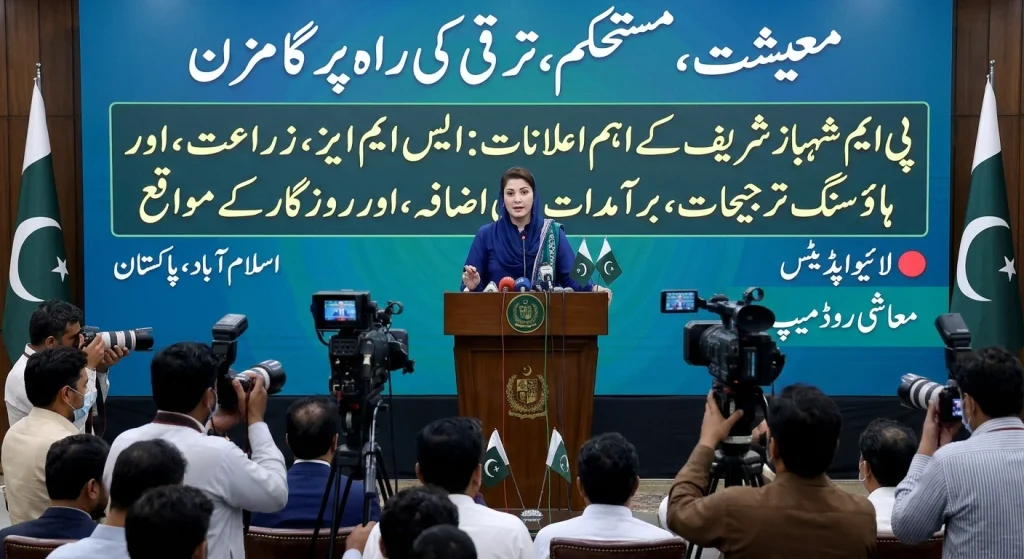
Punjab Chief Minister Maryam Nawaz has become the focus of political attention following two major developments in early November 2026. The first involves a Rs5 billion defamation notice issued to Federal Minister Chaudhry Salik Hussain over allegations of corruption against the Punjab government. The second is a province-wide sanitation directive that gives local authorities 15 days to improve cleanliness.
The legal notice has attracted particular attention because it involves a federal minister from the Pakistan Muslim League-Quaid (PML-Q), a political party that is part of the federal ruling coalition. It has also raised questions about political disagreements within the broader governing arrangement.
Maryam Nawaz has defended her government’s record and challenged the minister to provide evidence for his allegations. Salik Hussain, meanwhile, has said he stands by his comments.
Here is what happened, why the decisions are making headlines, and what they could mean for Punjab’s political and administrative situation.
Why Did Maryam Nawaz Issue a Rs5 Billion Defamation Notice?
On November 3, 2026, Maryam Nawaz announced that she was sending a Rs5 billion defamation notice to Federal Minister for Overseas Pakistanis Chaudhry Salik Hussain.
The notice followed remarks Salik made during a television interview on November 2. During the programme, he criticised aspects of the Punjab government’s administration and alleged that corruption was taking place in the province.
He also questioned the distribution of development funds, suggesting that a disproportionate share of Punjab’s development budget was being spent in Lahore.
Maryam Nawaz rejected the allegations and said that anyone making claims of corruption should provide evidence.
Addressing a ceremony in Attock, she said she would not accept what she described as false accusations against her government and would pursue legal action if the allegations were not supported by evidence.
The development quickly attracted attention because it turned a disagreement over provincial governance and public spending into a formal legal dispute.
According to reporting by Dawn, the notice also involved ARY News host Naeem Ashraf Butt and the channel’s chairman, Muhammad Iqbal. The recipients were asked to retract the remarks, issue an unconditional apology and clarification, and remove or correct the relevant portions of the interview.
The notice demanded Rs5 billion in damages and provided seven days for compliance, warning that legal proceedings could follow.
What Did Chaudhry Salik Hussain Say About the Punjab Government?
Chaudhry Salik Hussain’s comments came during a television interview in which he discussed the performance of Punjab’s political leadership.
He praised former Punjab chief minister Chaudhry Pervez Elahi, describing his administration favourably.
However, he also criticised the current provincial government, alleging that political considerations were influencing development priorities and public spending.
Salik said he regularly heard complaints about corruption in Punjab. He also questioned the use of public resources and argued that government officials should demonstrate the public benefits of expensive official travel.
His comments prompted a strong response from Maryam Nawaz and Punjab Information Minister Azma Bokhari.
Salik later said he stood by his remarks and had answered the interviewer’s questions honestly. When asked about evidence for his allegations, he advised the media to listen to the interview again.
The disagreement has therefore become a public dispute involving allegations, political responses and the possibility of legal proceedings.
It is important to distinguish between allegations made during a political interview and corruption established through an official investigation or court judgment.
Why Did the Dispute Become a Bigger Political Issue?
The controversy is significant because Chaudhry Salik Hussain belongs to the PML-Q, while Maryam Nawaz leads the PML-N government in Punjab.
Both parties are connected to Pakistan’s broader political coalition at the federal level, making the public disagreement particularly notable.
The dispute also involves questions about political influence over administrative appointments.
Maryam Nawaz said the disagreement was connected to her decision to replace the deputy commissioner of Gujrat. She alleged that Salik wanted an officer of his choice appointed to the position.
She rejected the idea that political figures should influence the appointment of government officers.
Punjab Information Minister Azma Bokhari also defended the provincial government’s position, arguing that administrative appointments should not be made according to political recommendations.
Salik, however, maintained that his criticism was based on his own assessment and the questions raised during the television interview.
The disagreement illustrates how disputes over government appointments, development spending and political accountability can create tensions even among parties associated with the same broader governing arrangement.
What Did Maryam Nawaz Say About Gujrat’s Development?
During her response to Salik Hussain, Maryam Nawaz also defended her government’s development record in Gujrat.
She recalled visiting the city during heavy rainfall approximately two years earlier. According to her account, the rainwater had risen significantly and submerged her vehicle.
She claimed that the situation had improved since then and that rainwater no longer accumulated in the same way during rainfall.
Maryam Nawaz used the example to challenge Salik’s praise for Pervez Elahi’s previous administration.
Her remarks brought attention to a broader political debate about development spending and the performance of previous and current provincial governments.
However, claims about improvements in drainage and infrastructure should be assessed through independent records, project details and local evidence rather than political statements alone.
Maryam Nawaz Gives Punjab 15 Days to Improve Sanitation
Apart from the defamation dispute, another recent decision by the Punjab chief minister concerns cleanliness across the province.
On November 2, 2026, Maryam Nawaz chaired a meeting in Lahore to review the Suthra Punjab sanitation initiative.
During the meeting, she gave authorities a 15-day deadline to improve sanitation conditions across Punjab.
Her instructions included:
- Daily washing of major roads.
- Strict fines for people throwing rubbish in public places.
- Improved cleanliness in markets, bazaars and vegetable markets.
- Cleaning villages on alternate days.
- Ensuring sufficient sanitation workers and machinery in every district.
- Timely payment of sanitation workers’ salaries.
- Introducing performance indicators for field monitoring officers.
- Weekly review meetings by deputy and assistant commissioners.
The government says the objective is to improve cleanliness and strengthen the implementation of Suthra Punjab.
The deadline puts additional responsibility on district administrations and local officials to demonstrate measurable improvements.
However, the success of the initiative will depend on implementation, monitoring, funding and the availability of sanitation staff and equipment.
What Is the Suthra Punjab Programme?
Suthra Punjab is a provincial cleanliness initiative intended to improve waste collection, sanitation and public hygiene.
Its activities include cleaning roads, removing rubbish, improving waste management and providing sanitation services in urban and rural areas.
The programme requires coordination between provincial authorities, district administrations and sanitation workers.
Maryam Nawaz’s latest instructions suggest that the provincial government wants more direct monitoring of local performance.
The 15-day deadline is particularly important because it gives district administrations a specific period in which to demonstrate improvements.
Residents will ultimately judge the programme through practical results, including cleaner streets, regular waste collection and better conditions in markets and residential areas.
What Does Maryam Nawaz’s Decision Mean for Punjab’s Politics?
The defamation notice and sanitation directive concern different areas of government, but both have attracted attention because they involve decisions made directly by the provincial chief minister.
The legal notice has created a political dispute involving a federal minister, a provincial government and media representatives.
Meanwhile, the sanitation deadline places pressure on administrative departments to improve public services within a defined period.
Several issues are now important to watch:
Legal developments: Whether the recipients respond to the defamation notice within the specified seven-day period and whether legal proceedings follow.
Political relations: Whether the disagreement between Maryam Nawaz and Chaudhry Salik Hussain affects relations between their respective political parties.
Administrative appointments: Whether the controversy leads to further discussion about political influence over provincial government postings.
Sanitation performance: Whether district administrations achieve measurable improvements within the 15-day deadline.
Public accountability: Whether allegations about corruption and development spending lead to the presentation of verifiable evidence and greater transparency.
These developments will help determine how the controversy evolves in the coming weeks.
Frequently Asked Questions
Why is Maryam Nawaz making headlines in November 2026?
She is in the news after issuing a Rs5 billion defamation notice to Federal Minister Chaudhry Salik Hussain over allegations of corruption against the Punjab government. She has also given authorities 15 days to improve sanitation across Punjab.
How much money is Maryam Nawaz demanding from Chaudhry Salik Hussain?
The defamation notice demands Rs5 billion in damages. It also asks for a retraction, an apology and clarification of the disputed remarks.
Why did Maryam Nawaz issue the legal notice?
She rejected Salik Hussain’s allegations of corruption and challenged him to provide evidence. She said she would pursue legal action over what she described as false accusations.
What is the 15-day deadline announced by Maryam Nawaz?
The Punjab chief minister has instructed district authorities to improve cleanliness across the province within 15 days, including road washing, market cleaning and regular sanitation in villages.
What is Suthra Punjab?
Suthra Punjab is a provincial sanitation initiative designed to improve waste collection, cleanliness and public hygiene in Punjab’s cities, towns and villages.
Has Chaudhry Salik Hussain withdrawn his allegations?
No withdrawal was reported in the latest coverage available on November 4, 2026. Salik said he stood by his remarks and advised the media to listen to the interview again.
Conclusion
Maryam Nawaz’s latest decisions have placed her at the centre of two important developments in Punjab.
Her Rs5 billion defamation notice against Chaudhry Salik Hussain has created a political and legal dispute over allegations of corruption, development spending and administrative influence.
At the same time, her 15-day sanitation deadline has placed district administrations under pressure to improve cleanliness through the Suthra Punjab initiative.
Both developments will remain important subjects of public discussion. The next developments will depend on the response to the legal notice, relations between the political parties and whether provincial authorities can deliver the promised improvements in sanitation.